

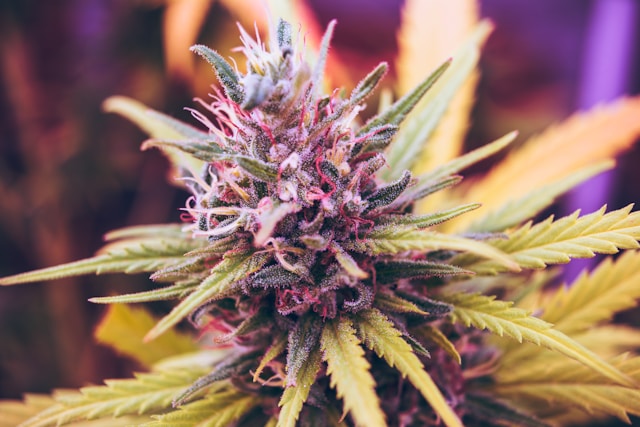
Photo by Esteban López on Unsplash
by Anthony Tomcykoski (ions)
Hemp-derived cannabinoids
Our bodies have an endocannabinoid system that responds to heterocycles at a receptor. Drugs fall along a spectrum of an agonist or antagonist, where the former produces a signal at a receptor site. Agonists in the cannabis plant include the cannabinoid THC, which binds to receptors in the body and signals cells to respond with intoxicating effects. Not all cannabinoids produce intoxication; however, many of the newer alternative cannabinoids (alt-noids) are stronger than natural cannabinoids.
Someone once said that marijuana stimulates the process of forgetting, in the sense that you don’t want to remember every little thing you see throughout the day. Many people enjoy these effects without a negative impact on their lives. For instance, let’s say you have a traumatic experience. The effects of THC can help you deal with moving on and not having to recall the event as impactfully as it might otherwise have been.
Our legislatures have allowed us <0.3% THC by weight to be cultivated and sold. THC and hemp-derived psychoactives allow intoxicating products to be available in a largely grey area. However, by November 2026, United States hemp-derived intoxicants will be illegal and back to a prohibition era. And in essence, nearly all the hemp grown in the United States allowed by the 2018 farm bill will become illegal and has to be destroyed.
History of Cannabis Laws
Drug laws pursuant to cannabis date back to the Middle Ages. During the Industrial Revolution, a push for cannabis laws occurred. The most notable law in the United States was the Marijuana Tax Act of 1937 championed by Harry J. Anslinger, first commissioner of the Federal Bureau of Narcotics, and was largely based on politics and rooted in racism. It imposed an excise tax on sale, transfer, and possession of all hemp plants. During World War II, a short film was produced called Hemp for Victory, arguing that America should produce hemp to win the war. Then in 1970, President Nixon signed the Controlled Substances Act as part of the war on drugs which placed marijuana in a schedule I category alongside heroin and LSD. He couldn’t make being a hippy a crime, but he could criminalize the drugs hippies used to get high. Come 1996, California made medical marijuana available for qualifying conditions. Many states followed this. Then in 2012, both Colorado and Washington made recreational cannabis legal. Again, many states followed suit.
Legal States
States that surround Pennsylvania, except West Virginia, all have legal recreational cannabis. It is legal at a state level, but still a controlled substance at a federal level. Pennsylvania is still a prohibition state as of 2026. We have a medical program that has been described as a dirt market and overpriced. New York, New Jersey, Delaware, Maryland, Ohio, and even Canada all have a legal market. There has been a push at the executive level to move cannabis to schedule III and that falls short or even makes the law worse for users. It would make a push for ‘big cannabis’ or let pharmaceutical companies control the market and hurt private growers. What a lot of smokers want is to deschedule it and treat it like tobacco or alcohol. Our governor in Pennsylvania wants recreational weed, but it gets backlogged in the assembly. What floods our tobacco shops are kratom and its extracts.
All of this wrangling over the legal status and commercialisation of cannabis perhaps obscures the basic fact that cannabis allows you to explore realms of consciousness not attained without it. Some claim that medical treatment is not the only approach to using a drug. Mysticism and spiritual healing are another idea. Entheogens may help an individual find God or at least be at peace in the physical world. Psychoactives could very well help someone prepare for the afterlife where, in my belief, the mind lives on. Who knows if we will have a body in the next life. I think it’s the mind that is eternal, where there is no longer pain or pleasure.
Medical states.
There are several states that allow medical access to marijuana outside the zeitgeist of state-allowed recreational consumption. The process to achieve legal access in a medical state requires documentation from your primary care provider to a licensed physician (M.D.) to enable a state-issued card to gain entry into a dispensary. The product is inferior to legal states, and lacks the levy of a free market. By comparison, home grows allow growers to experiment with genetics rather than relying on a medical state-based model where there is no need to make it any better since there is no competition.
Prohibition states.
In the case of a prohibition state, possession, sales, cultivation etc. laws persist and lead towards incarceration or worse for simply growing a plant medicine. I would like to see an amendment passed that states ‘all plant medicines are legal.’ Interpret it how you’d like, but growing a plant should not be a crime. Non-violent offenders largely occupy prison cells for profit on a private level. This has led to a situation where 1 in 3 Americans have a criminal record, with many suffering the tedium of serving time for victimless crimes.
Black Market
So in a prohibition state like Pennsylvania, where can you acquire weed? Many people go to festivals and source. New York, the home of Woodstock, has an abundance of music festivals like you have never seen. And since the advent of recreational cannabis in the state of New York, prices have plummeted.
International Law
You can’t be involved with European cannabis here in the US. The US cannabis market is largely localized and prohibited. The Netherlands started strong but seems to be at a standstill in pushing the recreational market. Germany, Czech Republic, Luxembourg, and Malta have legal cannabis. Treating cannabis like honey export is ideal. You like to try exotic honeys but local is preferred.
Homegrown/budder
A simple recipe for making cannabis budder is using bud flower and cooking it on low in a crock pot for 3-4 hours. An eighth of bud and a stick of butter is a good ratio. Trim is preferred as it contains THC and would be otherwise disposed of, so you might as well use it. Filter the plant material with cheese cloth. I use a mason jar and ring lid to allow for filtration. Then pour the dairy into a mold, set to solidify, and use in cooking. It’s decarboxylated and intoxicating as eaten.
References
Peter Grinspoon, “The Endocannabinoid System: Essential and Mysterious,” Harvard Health Publishing, August 11, 2021, https://www.health.harvard.edu/blog/the-endocannabinoid-system-essential-and-mysterious-202108112569.
Sensi Seeds, “Effects of Cannabis on Memory: Remembering & Forgetting,” Sensi Seeds, October 28, 2020, https://sensiseeds.com/en/blog/effects-of-cannabis-on-memory-remembering-forgetting/
Various Editors, “Marijuana,” History, May 31, 2017, https://www.history.com/articles/history-of-marijuana.
Office of the Attorney General, “Justice Department Places FDA-Approved Marijuana Products and Products Containing Marijuana Subject to a Qualifying State-issued License in Schedule III, Strengthening Medical Research While Maintaining Strict Federal Controls,” April 23, 2026, https://www.justice.gov/opa/pr/justice-department-places-fda-approved-marijuana-products-and-products-containing-marijuana.
Mitch Earleywine, Maha Noor Mian, Brianna Altman, Joseph De Leo, “Expectancies for Cannabis-Induced Emotional Breakthrough, Mystical Experiences and Changes in Dysfunctional Attitudes: Perceptions of the Potential for Cannabis-Assisted Psychotherapy for Depression,” Cannabis, July 11 2022, Vol. 5 No. 2 (2022): Cannabis.
Anthony Tomcykoski (ions) is the Director of the ions institute (not to be confused with the Institute of Noetic Sciences). He has a BS in Chemistry (2006) from Commonwealth University – Mansfield, and completed a Ph.D. dissertation in inorganic chemistry at Binghamton University, with a focus on ruthenium (II) hemilabile coordination compounds. He’s currently living in Pennsylvania. In his free time he invests in the markets.