

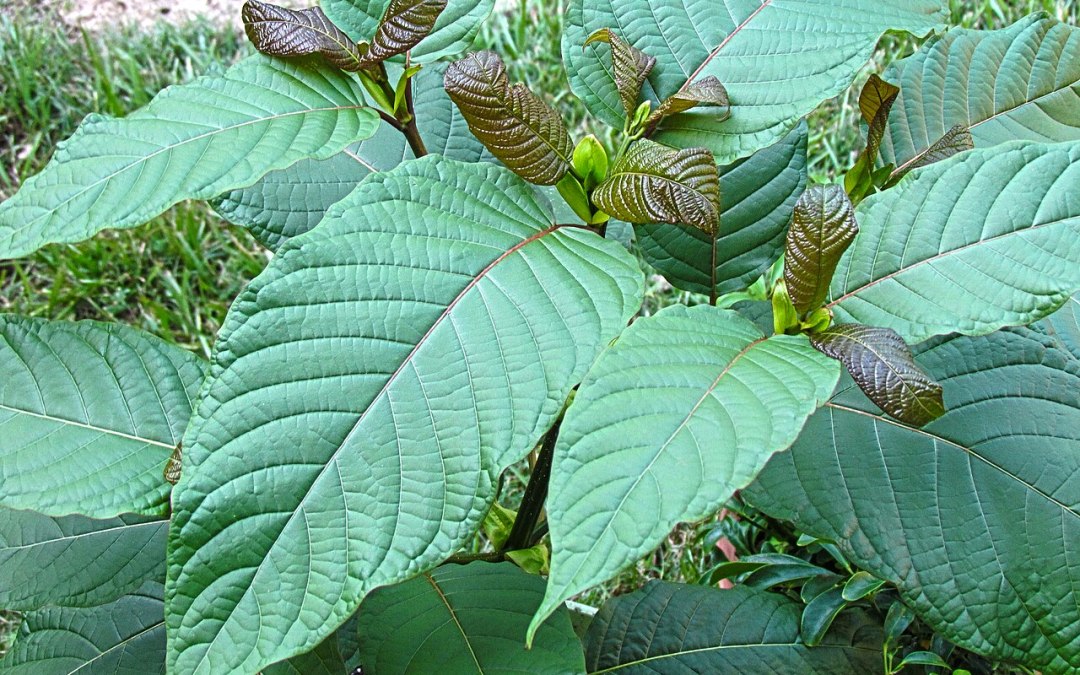
Mitragyna speciosa tree. Image by ThorPorre.
by Jay Davis
Towards the end of July 2025, the US Food and Drug Administration (FDA) wrote a letter to the Drug Enforcement Agency (DEA), recommending that 7-hydroxymitragynine (commonly known as 7-OH or 7-OHM) be added to the Schedule 1 classification of controlled substances. This dubious designation, reserved for drugs with no known medical application and a high risk of abuse, is a windowless box into which the federal government has placed countless drugs and medications over decades, limiting the potential for medical research in addition to public accessibility. The legality of 7-OH is distinct from traditional kratom leaf, as it is a metabolite of kratom, and exists as a separate extract of the plant. Kratom is currently regulated in some capacity in 24 states and the District of Columbia, but remains unregulated at the federal level.
While the prevalence and availability of kratom has increased over the past 20 years, 7-OH as a standalone extract is a relatively new phenomenon. Standard kratom leaf is typically dosed in multiple grams, while 7-OH doses are measured in milligrams. Ground up kratom leaves are derived from a tree called Mitragyna speciosa, indigenous to Southeast Asia. While it’s said to have been used for thousands of years, it first appeared in scientific literature in the 19th century. It was first used as a substitute for opium, and to assist peasant farmers getting through long and grueling hours of work. There are many active alkaloids within kratom, creating a mild analgesia, stimulation, and anxiety relief. These effects occur simultaneously and to varying degrees depending on personal chemistry, and the potency and quality of the kratom or extract used. The pharmacology of all these alkaloids is somewhat diverse, and is still being debated and researched, but the effect people typically seek from kratom is its activity as an opioid receptor agonist. 7-OH and mitragynine are the primary alkaloids responsible for its psychoactive effects. 7-OH owns the distinction of being the most potent and effective at activating the opioid effects. Kratom and its alkaloids are not derived from the poppy, so while they are considered opioids, they are distinct from traditional opiates. Kratom’s partial receptor agonism limits the potential for respiratory depression, dependence, and risk of overdose in comparison to traditional opiates. Typically the worst effects from an overdose of kratom are extreme nausea and vomiting. There is still a risk of potentially deadly overdose when combining kratom with other sedatives like alcohol, benzodiazepines, or other opioids.
This isn’t the first time a US government agency has attempted to schedule kratom or its alkaloids. In August 2016, the DEA published a Notice of Intent to add mitragynine and 7-OH to Schedule 1. This scheduling attempt caused great public outcry from American citizens. People dealing with chronic pain, mental illness, and substance use disorder who have benefited from kratom ultimately came together to resist this scheduling intent, with several US senators speaking up for their constituents. Advocacy groups such as the American Kratom Association (AKA) helped push for more sensible regulation of this widely used herbal medicine. The DEA ultimately withdrew their notice in October 2016, requesting that the FDA continue medical research to better inform any future scheduling action. The AKA has been instrumental in passing legislation that carefully regulates kratom products, and protects its use legally, through a model bill called the Kratom Consumer Protection Act.
In 2021, the Substance Abuse and Mental Health Services Administration (SAMSHA) stated that 1.7 million Americans aged 12 or older used kratom. People across all demographics have reported that the legal availability of kratom and 7-OH has helped them with a range of problems such as chronic pain, anxiety, depression, opioid substitution, and fatigue.
Kratom is of course not without its potential dangers. Physical and psychological dependence and overdose, while less likely than with traditional opioid medicines, are still real risks that people need to consider if they decide to use kratom or its alkaloids. A CDC report looking at 27,338 unintentional overdose deaths found the presence of kratom in 152 (0.56%) deaths, from July 2016 – December 2017. The overwhelming majority of these deaths were of a polysubstance nature, with only 7 deaths being attributed to kratom alone. While there are risks to the use of kratom, I believe it’s important we look at the actual facts when considering whether we want to criminalize its sale, use, and possession.
The US has a long history of government overreach regarding public drug use. There are too many examples to show how the lasting tendrils of an antiquated Drug War have brutalized American communities. From increasing overdose rates, mass incarceration, the expansion of organized crime, diminishing access to pain relief for those who need it, and an ongoing mental health crisis, there is no shortage of clear evidence that the criminalization of substances widely used by the public is destroying lives. How can we continue to consider substances for Schedule 1 that have demonstrable medical benefit? I fail to see the benefit in using state authority to criminalize behavior that such a large number of Americans engage in without issue, such as recreational drug use. What do we gain from incarcerating nonviolent citizens, while our economy falters and public faith in institutions is already at an all time low? There is no shortage of fear-mongering reading material which compares kratom to “gas station heroin”. Even an advocacy group like the American Kratom Association is lobbying for this 7-OH ban, hoping that this stance will somehow protect access to kratom leaf. I do not see the logic in their position, as the government doesn’t seem to understand nuance regarding public drug use. It is very difficult to not grow very cynical about all of it. I fear that this legislation will cause further suffering among those who benefit from the legal availability of 7-OH. Putting 7-OH into schedule 1 will greatly restrict the possibility of medical research and development.
The Drug War only seems to have a growing list of victims. The street drugs only get more potent and poisoned, with fentanyl and nitazenes mostly replacing heroin. These drugs have proven to be deadlier than traditional opiates, and many folks come to use harder drugs due to a lack of access to proper pain management and relief in this country.
But it never seems to be good enough, right? It’s not enough that people can hardly afford food or healthcare despite their hard work. It’s not enough that the lack of safe supply kills thousands yearly. It seems we also have to turn people into criminals for treating their pain. The same federal government that has incarcerated millions for marijuana possession, that profits from global narco terrorism, is the same one policing whether you are allowed to relieve your pain or not.
I reject the premise of all of this wholeheartedly. Modern drug policy is rife with contradictions and smacks of a national culture of social and moral control. It is far past time that American public officials supported harm reduction practices, and ended the War on Drugs. You cannot incarcerate your way to a pristine and sober society. People need a safe supply, for many of the same reasons we repealed alcohol prohibition. That is the bottom line, and I will remain optimistic that truth, science, sensibility, and morality will eventually have their day in America.
I’ve tried to present an objective glance at this matter in this article, but I won’t deny that I have a personal bias here. I rely on legal access to kratom and 7-OH to get through the day. I first started taking kratom in 2014, primarily as an alternative to alcohol and a relief for anxiety and depression. In 2024, I broke three bones in my leg and ankle, which required the surgical implant of 2 titanium plates and 14 screws. I couldn’t walk for 4 months, and I’ve had to undergo the arduous process of slowly gaining my strength back and fighting my way back to a normal life in which I can do physical work and contribute to society. It has taken some time, but through physical therapy, yoga, and the availability of safe pain relief, I am able to work 40-60 hours a week in a physically demanding career. I have major doubts that I will ever be afforded safe access to the pain relief I require through a doctor. I can barely get health insurance. This kind of story is all too common in America. Despite being nominally dependent on kratom, I can’t identify any negatives that kratom has brought into my life, aside from financial expense, despite using it long term. 7-OH use definitely has its risks, but I believe it has therapeutic potential as well. It has taken decades to see key research into the benefits of cannabis, psilocybin, and MDMA after they were placed in Schedule 1, and I would argue that a similar scheduling of 7-OH would be a mistake.
If this article resonated with you, I would urge you to reach out to your local officials and ask them to stand against the DEA’s proposed scheduling of 7-OH, and to support the implementation of a Kratom Consumer Protection Act in your state. I would urge you to support the American Kratom Association. Despite my disagreement with their position on 7-OH, I still believe they do important work. I reached out to my senator in 2016 when the legality of kratom was originally threatened, and he ended up being one of the senators that defended safe access. You may be surprised what you can achieve by reaching out to your public officials.

Jay Davis is a writer, artist, activist, and Bluelight contributor from the Washington, DC area.
Disclaimer: This article is provided for informational purposes only and is not intended as legal, medical, or professional advice. Always seek the guidance of a qualified health professional regarding any questions you may have about drug use, harm reduction, or your health. Laws regarding drug use and online activity vary by location—ensure you understand the laws applicable to you before taking any action. Views expressed in the article are the author’s, and do not necessarily reflect the views of Bluelight Communities Ltd.